Godrej Consumer Products · 2018–2019
Launching a rural-first product to ~$3M in first-year revenue
Designing a rural-first launch around consumer insight, a locally resonant proposition, vernacular demand creation and distribution readiness.
Consumer insight · Product proposition · Media · Distribution
01
The business tension
Entering mosquito-repellent incense meant competing in a locally fragmented format while extending Goodknight’s trust into a new ritual and price point.
Before defining the product, I participated in consumer research and trade visits across Andhra Pradesh, Karnataka, Maharashtra, Tamil Nadu, Odisha, West Bengal and Bihar. The work examined household practices, local incense habits, retailer influence and the cultural language people used for mosquito protection.
02
What I saw
Across markets, neem and haldi repeatedly surfaced as powerful vernacular associations with herbal mosquito removal. They were not generic ‘natural’ ingredients; they were culturally encoded signs of trusted household protection that consumers understood immediately.
The trade immersion also made the commercial system visible. Winning required a product and proposition that felt locally legible, supported by retailer advocacy and available through the wholesale, sub-stockist and rural retail networks where the category was actually bought.
03
The strategic choice
Consumer evidence led to neem and haldi as the central product and communication associations. Lab research then supported the efficacy proposition, translating cultural familiarity into a credible product promise built around three-hour protection, natural ingredients, pleasant fragrance and lower smoke.
I built the launch around format relevance in rural markets, linking that proposition to vernacular media, local advocacy, trade education and a deliberate distribution build.
State priorities reflected category penetration, salience and route-to-market potential; media followed those choices instead of imposing one national template.
04
The operating model
Seven-state consumer research and trade immersion identified source of business, product relevance and cultural codes.
Neem and haldi became a memorable herbal-protection proposition, supported by laboratory research.
Regional media, vernacular digital, local influence, trade education and distribution readiness.
Brand, insights, sales, trade, distribution and agency partners aligned behind one launch plan.
05
Activation
- Combined regional television and news, local talent, vernacular digital content, local creators and contextual communication in smaller towns.
- Equipped field teams and trade partners with product demonstrations, samples and retail materials.
- Connected demand creation to wholesale, sub-stockist and retail availability so awareness could convert into trial.
Selected evidence
The work in market
Campaign and product proof
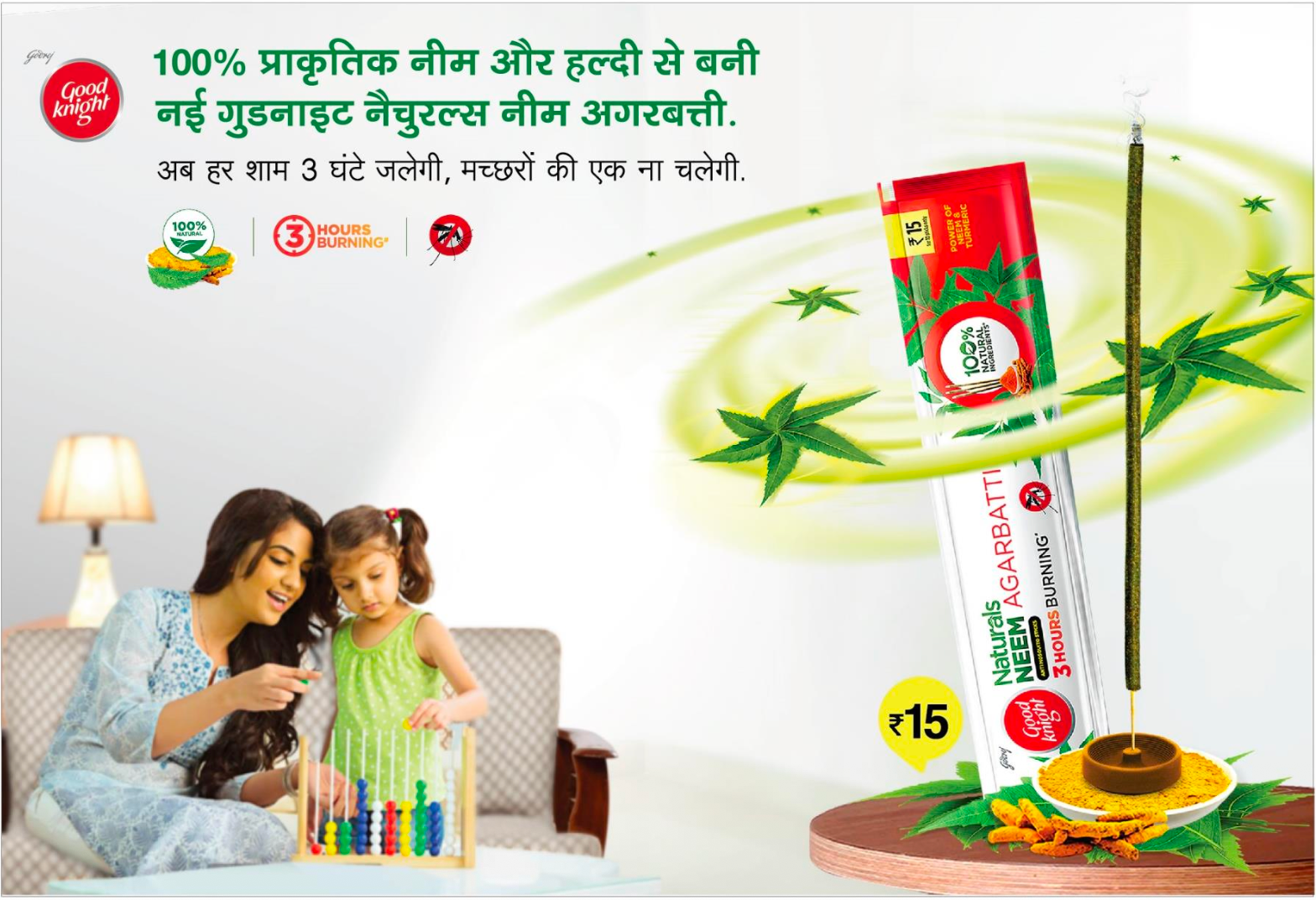
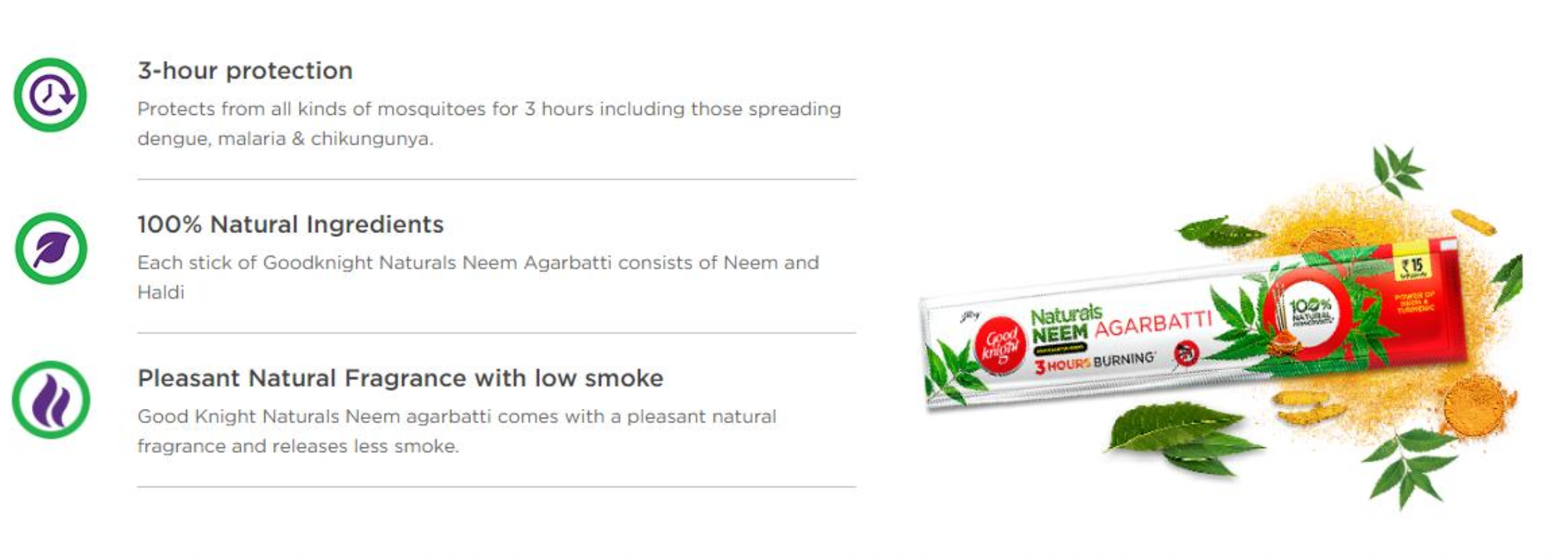
The campaign connected a culturally familiar ingredient story to clear functional proof: three-hour protection, natural ingredients, pleasant fragrance and lower smoke.
06
Commercial movement
Goodknight Neem Agarbatti generated ~$3M in first-year revenue.
The case remains an enduring proof that consumer strategy and route-to-market execution must arrive together, especially when the market’s behaviour cannot be understood through an urban lens.
07
Reflection
A rural-first launch is not an urban campaign with vernacular creative. It begins with a different source of business and succeeds only when product meaning, media habit, trade education and physical availability arrive together.